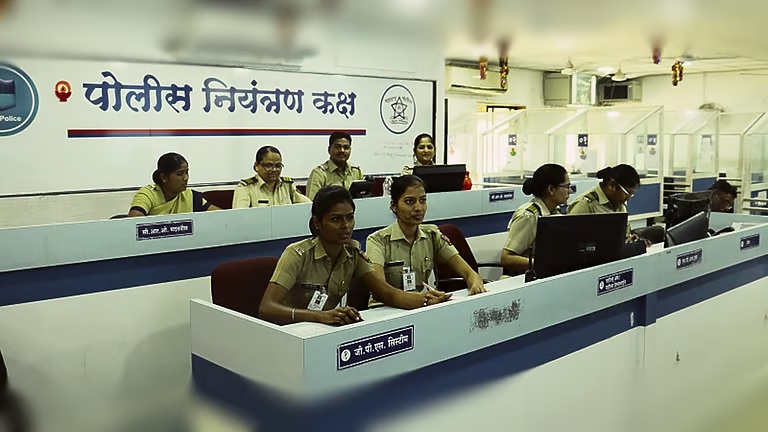
Are Indian police control rooms merely places for cops to rest or safe havens for those facing serious charges, or is there more to their role and purpose? Let’s try to find out what police control rooms truly represent.
The events surrounding the toxic liquor scandal in Pune and Pimpri-Chinchwad have brought attention to alleged connections between police personnel and the illegal liquor trade. With several of these officers transferred to the Police Control Room, the nature and significance of control room postings are under renewed scrutiny.
First, let’s start with the basics. The control room, or Niyantran Kaksha, functions as a central hub for emergency response. Experts working within the department handle 100/112 calls. They monitor the ground situation and coordinate with police stations as well as field units to dispatch help. Officials also monitor the traffic situation and the CCTV feed from key establishments in the city or region. Further, they coordinate with state and central reserve forces, the cyber cell, and other departments, including local bodies, as needed. All in all, it is considered the most crucial unit in the law-and-order mechanism.
You might wonder, which officials are present in the control room at all times? Depending on the jurisdiction, there’s a main control room as well as regional ones in various parts of the city and suburbs. Officials such as Police Inspectors, APIs, Senior PSIs, ASIs, Police Constables, Wireless Operators, and PCR Van Staff are present in the control room at all times. Depending on their designation, they are expected to handle various responsibilities. Other professionals, like IT specialists and CCTV surveillance system operators, are also present twenty-four hours a day. Operations are overseen by a DSP (Deputy Superintendent of Police) or a higher-level official.
So, why is the control room posting considered a punishment post? Well, first of all, cops lose their jurisdictional power along with the perks associated with active police station postings. It is considered a punishment posting or a bench for officials facing disciplinary action, including investigations into corruption or departmental inquiries. It is a demotion and loss of prestige. Besides punishment postings, officers looking for a short break, or those suffering from a medical condition, are also assigned a role at the control room. It is crucial to note that all transfers are carried out in accordance with the rules laid down by the Maharashtra Police Establishment Board. But who else can explain the perspective better than cops themselves?
Known as an anti-corruption crusader in the Mumbai Police Force, Police Sub-Inspector Sunil Toke, who fearlessly presents the bitter truth to the media, expressed his views on this matter. He said, “Police officers and personnel embroiled in inquiries are temporarily transferred to the control room until the discussion on this poisonous liquor case continues among the general public and the media. Once the public chatter dies down, these loyal officers, who are favorites of some senior police officials, are transferred back to the same location or to a lucrative ‘cream’ posting as a part of their reinstatement. This entire process is given a fancy label: ‘transferred due to administrative reasons.’”
“After working in the field for eight years, I requested higher-ups to give me a stress-free assignment or duty for a few days until I get promoted as a senior police inspector. And they gave me a duty at the Chembur Control room in Mumbai,” said Retired Assistant Commissioner of Police, Suresh Walishetty, during one of his recent interviews with senior journalist Hussain Zaidi. So, one aspect is crystal clear that the work pressure is considerably less in control room jobs.
Why are cops given punishment postings while facing an inquiry? Why can’t they be dismissed directly? The procedure for removal or dismissal differs on the basis of the police officer’s rank. But the common aspect is that the appointing authority has the power to dismiss or remove an officer after following the due procedure of law. And the most vital point is that no officer can be removed, dismissed or demoted without completing a proper departmental inquiry. There are exceptions. For example, cases where an officer is caught in extreme acts of terror, extortion, or deep institutional corruption.
Besides control room postings, which other postings are considered punishment postings in the Maharashtra police? In addition to control room duties, several other assignments in the Maharashtra Police are considered punishment postings. The list includes transfers to police headquarters (police lines), the Maharashtra Police Academy (MPA), the State Reserve Police Force (SRPF), the Maharashtra State Security Corporation (MSSC), and the Home Guards department. Further, even field postings to Maoist-affected regions are also treated as punitive actions. But a control room posting works as a great temporary solution.
Need fresh content to engage your audience? Let Nitten help you with 100 percent human-written blog posts, articles, and press releases on a variety of topics at highly affordable rates. Don’t have a big budget for content? No worries, Nitten can still help! He can assist you with story ideas and getting the best content from AI tools like ChatGPT, Gemini, Co-Pilot, etc. Feel free to get in touch: nittengokhaley24@gmail.com
 Cyber Journal 24
Leave a comment