American intelligence gathering agency CIA recently used a YouTube video and the social media platform Telegram in an attempt to recruit Russians. The agency usually recruits via colleges and other government agencies in the US. However, since 2020, it has taken several out-of-textbook ways for finding and hiring human resources.
You might wonder, why has the CIA changed its recruitment ways? To get the answer, we must look at the agency’s history, past and current missions.

The organization’s history
The American Central Intelligence Agency was formed with inputs from defense leaders, the military, state governments, and the public. President Harry S. Truman passed the National Security Act, leading to the formation of the CIA in 1947.
No doubt, it is the most sophisticated and resourceful intelligence gathering agency in the world. Yet, during the 75 years of existence, the agency’s operatives also made it to the headlines due to their interrogation techniques. The CIA attracted criticism due to the brutal Phoenix Program in Vietnam, and the failed Bay of Pigs landing. The world has also not forgotten Aldrich Ames. The Russian intelligence mole continued working as a top official within the CIA for a long time.
Current and past missions
The agency keeps on adapting to new trends and leads. As highlighted by former CIA director George Tenet, disrupting international money transfers initiated by terrorists, or obstructing other terrorist activities are included in the list of CIA’s covert operations. Most importantly, the agency also gathers information about possible attacks on U.S. embassies. Further, there is the important task of monitoring military research carried out by hostile governments. No wonder. Gaining more insights into Russia and China has been the top agenda for the CIA during the recent years.
Now, the focus is also on counterterrorism and cyberwarfare.
Usually, how does the agency recruit?
The CIA has field officers, analysts, case officers, scientists, and engineers working for the agency. The organization does not disclose details about employees or the overall workforce size. Yet, sine estimates suggest the worldwide headcount is more than 21,000.
Author Daniel Golden’s book titled Spy Schools offers a glimpse into how the FBI, CIA, and other agencies recruit American students from schools and universities. Such establishments also create connections with foreign students and professors. Yes, to convenience them to work for the CIA once they return to their home country. Further, roughly 20 percent of new hires are recruited while in their mid-career. The list includes cyber experts, former military or paramilitary officers.
To sum it up, having a college degree is crucial to qualify for CIA jobs. But, some positions are open for high school graduates, and college students. The CIA also needs individuals who speak Chinese Farsi, and Korean. Basically, expertise in foreign languages proves a plus point. Special initiatives are designed to attract minorities and women.
Security checks and clearances
CIA officials handle extremely sensitive, national security-related information. So, candidates need to clear extensive background checks before they start working for the Central Intelligence Agency. The security clearance involves interaction with people that the recruited person has lived or worked with. The time frame for the entire procedure can extend to as much as two years. Merely 17 percent of those who receive conditional offers manage to clear all rounds of checks.
A recent series of unusual steps
What’s wrong with embracing new marketing tools? Nothing, right? Thus, the CIA mended ways with time and now has a website, an Instagram page, and a YouTube channel. The agency has radio, television, and online advertisements for recruitment. The CIA’s first unusual move was their TV advertisement with regard to recruitment in June 2020. To focus on a broader group of potential recruits, the agency runs advertisements on streaming platforms like Hulu. It also keeps its eyes on college campuses as well as local science fairs, like in the 80s.

This may sound weird, but the agency recently tried to recruit Russians as intelligence officers via social networking platforms. And agency’s Director William J Burns publicly agreed about the recruitment drive while delivering a lecture at an annual event held by the Ditchley Foundation in the UK.
“Several Russians are feeling disenchanted due to the Russian invasion of Ukraine. They are unhappy with the state of affairs under Putin’s rule. And thus, this is a crucial opportunity for the American agency to appeal for information and recruit,” said Burns.
The CIA’s first attempt towards the same was made last year. The agency had urged Russians to safely contact the CIA and share information about Russian operations related to the Ukraine war via the dark web. Further, in May this year, the agency posted a video titled, “Why I made contact with the CIA: My decision.” Besides the CIA’s Telegram channel, the video was also posted on Facebook, Twitter, Instagram, and YouTube. The cinematic recruitment video is described as a slickly produced one. Yes, the video managed to cross 2.5 million views during the first week itself.
Did these campaigns work? Well, officials suggest they did receive some responses with vital data.
CIA faces the risk of being fed unreliable data from Russia
There is always a great risk involved in moving too fast and trusting unreliable sources. Sometimes foreign informants pose potential counterintelligence risks. They may turn into double agents and feed disinformation to the American intelligence agency.
There are risks to informants as well. Russia, China, Iran, and others use facial recognition, biometric scans, artificial intelligence, and other advanced technologies to track foreign intelligence-gathering officials. Several informants in China and Iran were exposed when the agency’s classified communications system was hacked. Some of these individuals were arrested and even executed. Overall, the spy agency has lost hundreds of operatives in Pakistan, Iran, China, and Russia during the last decade alone.
By: Nitten Gokhaley
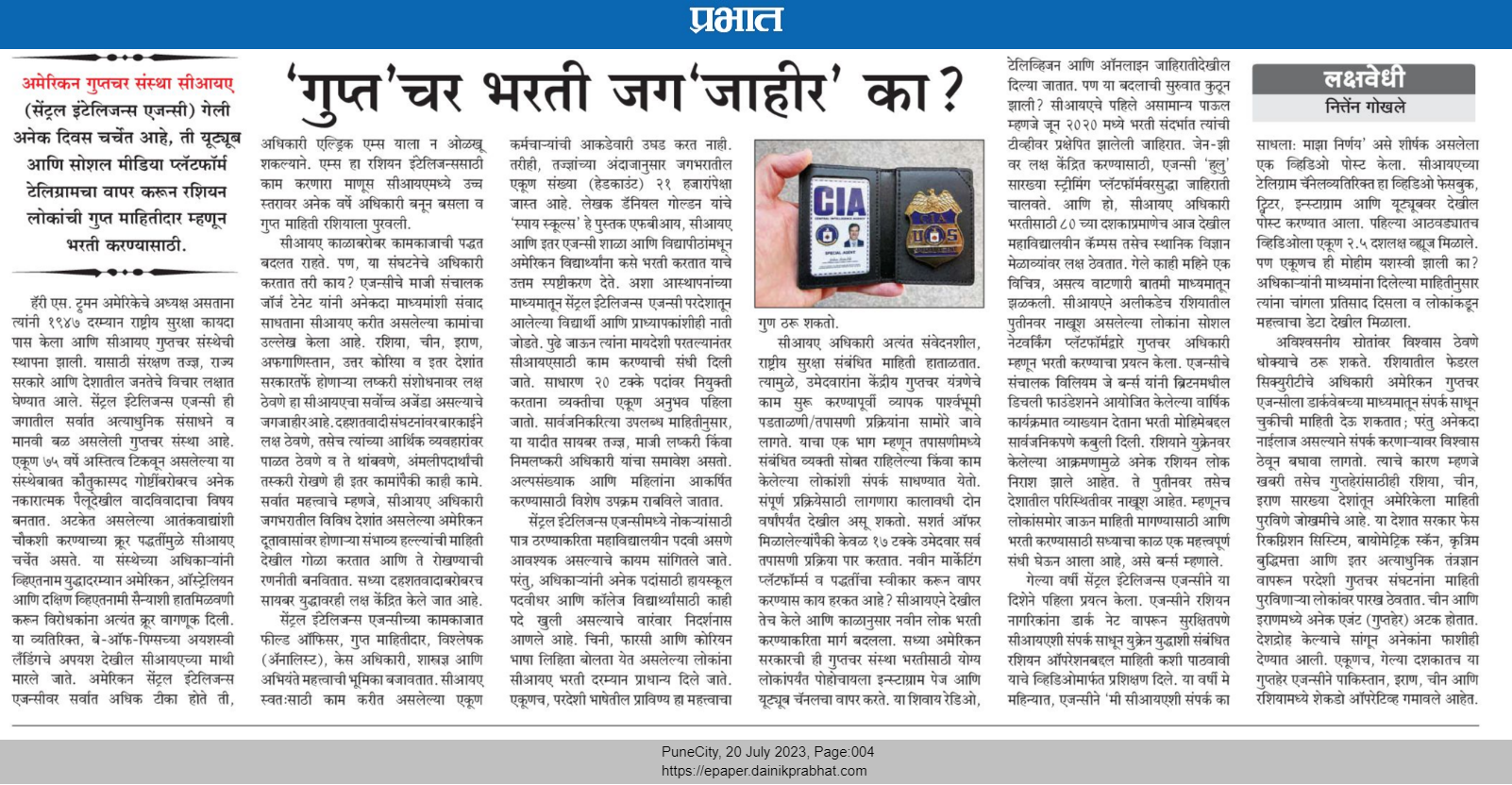
The column’s Marathi version was first published by Prabhat Daily, Pune, in July 20, 2023 edition.
 Cyber Journal 24
Leave a comment